

How US, Canadian and UAE Companies Can Choose a Software Development Partner in India
India offers a large technology talent pool and strong experience delivering products for global companies. That does not make every vendor interchangeable. The right software development company in India can provide product thinking, specialised skills and efficient delivery. The wrong one can create unclear ownership, fragile code and expensive delays.
For companies in the USA, Canada, the UAE and wider Middle East, selection should go beyond hourly rates. This guide provides a practical framework for evaluating a long-term technology partner.
Define the engagement you actually need
Different problems require different partners. You may need an agency to design and build a complete product, a dedicated team that extends internal engineering, or specialists for AI, mobile, cloud or CRM work.
Clarify who owns product management, architecture, design, quality assurance and deployment. If your company has only a business idea, choose a partner capable of discovery and product definition. If you already have technical leadership, staff augmentation may be more appropriate.
Evaluate domain and technical relevance
Look for evidence that the team has solved comparable problems. Industry experience can help with workflows and terminology, but technical similarity is also important. A logistics platform, for example, may require role-based dashboards, real-time status, integrations and auditability even if the agency has not built the exact same product.
Ask to see case studies that explain the problem, solution, architecture and outcome. Discuss what the team would change if it rebuilt the project. Honest reflection is a stronger signal than a flawless sales story.
Assess product thinking
A good partner does more than accept a feature list. It asks who the user is, why the workflow matters, how success will be measured and what can be deferred. This prevents months of development on assumptions that could have been tested earlier.
During initial discussions, notice whether the team identifies dependencies, edge cases and operational needs. For example, a customer-facing app often requires an admin panel, support process, analytics and content management that are easy to overlook.
Make communication observable
Remote delivery depends on written clarity and predictable communication. Ask how the team runs discovery, demonstrations, issue tracking and approvals. Identify the project lead and the people who will actually work on the product.
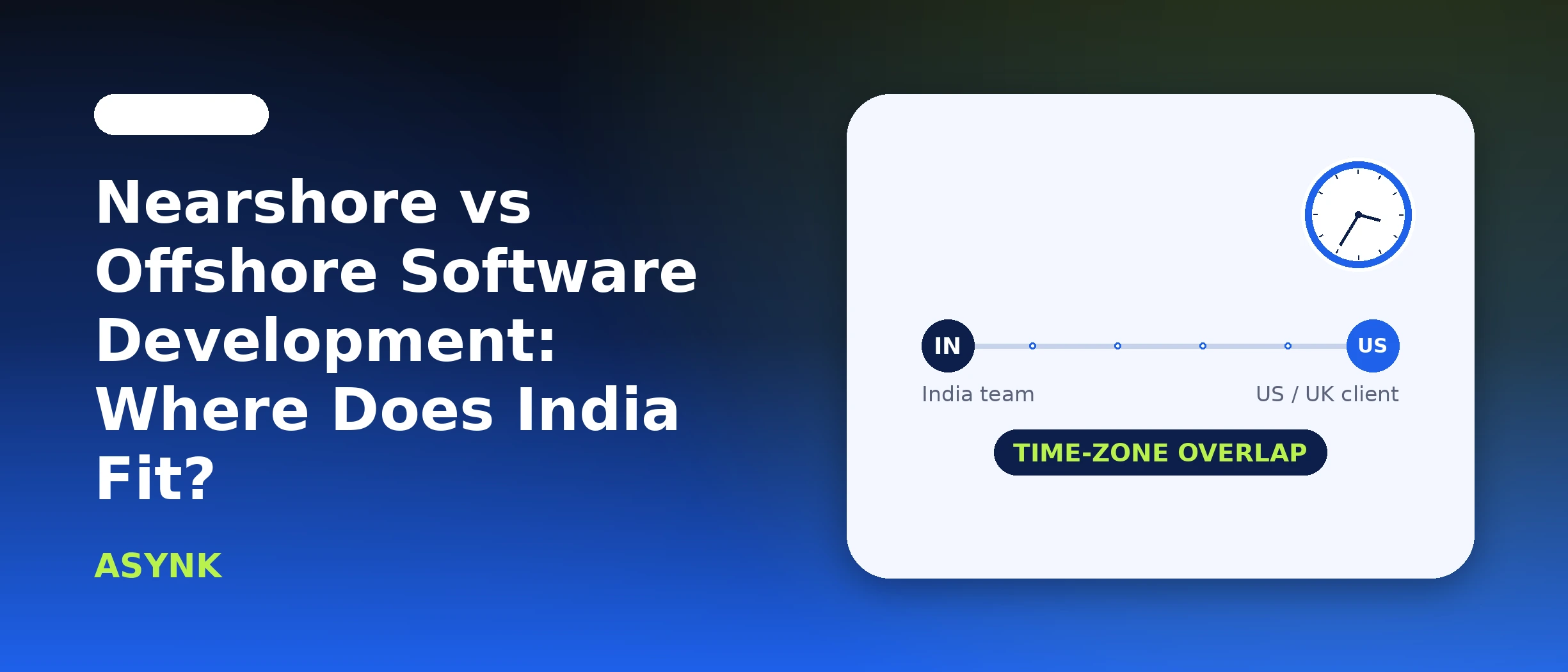
For North American clients, an Indian team can arrange overlap at the beginning or end of the day. UAE and India have a smaller time difference, making live collaboration easier. Continuous overlap is not necessary for every task, but decisions and blockers need a reliable window.
Request a sample status report or project plan. Clear documentation reduces dependence on meetings and protects continuity when team members change.
Compare teams, not blended rates
An hourly rate does not reveal output quality. Ask which roles are included, their experience levels and expected allocation. A lower rate with weak product management or QA may require more client oversight and rework.
Compare the full delivery model: discovery, UX, engineering, testing, DevOps, project management and support. Fixed-price projects can suit stable scope, while time-and-materials models suit evolving products. A milestone model can balance predictability and learning.
Review architecture and engineering standards
The partner should explain how it approaches code review, environments, testing, deployment, monitoring and documentation. Ask how technology choices relate to your scale, hiring plans and existing systems.
Avoid unnecessary complexity. A new product rarely needs an elaborate distributed architecture on day one. It does need clean boundaries, secure configuration, backups and a path to evolve.
If AI is involved, ask how models are evaluated, how sensitive data is handled, how costs are monitored and what happens when a provider changes. The application around the model is as important as the model itself.
Set security and privacy expectations
Security requirements vary by product and market. At minimum, discuss access control, authentication, secrets management, dependency updates, encryption, logging, backups and incident handling.
For regulated or sensitive workloads, involve appropriate legal, compliance and security experts. Confirm where data will be hosted and which subcontractors or cloud providers may access it. A generic promise of complete security is not a substitute for defined controls.
Protect ownership in the contract
The agreement should cover scope, deliverables, acceptance, payment, intellectual property, confidentiality, third-party components and termination. It should state how source code, repositories, cloud accounts, designs and documentation will be handed over.
Keep core accounts under the client's ownership where practical. Give the delivery team role-based access rather than allowing essential infrastructure to exist only in a vendor-controlled account.
Also define how change requests are estimated. Software requirements evolve; a transparent change process prevents every new insight from becoming a commercial dispute.
Start with a bounded engagement
Before committing to a large roadmap, run a discovery sprint, prototype or tightly scoped module. This reveals how the team communicates, reasons about trade-offs and handles feedback.
Set tangible outputs: user flows, technical approach, prioritised backlog, prototype, risk register and delivery estimate. Even if you do not continue, these assets should remain useful.
Plan governance and quality
Agree on a regular rhythm for backlog review, demos and release decisions. Define acceptance criteria before development and include both functional and non-functional needs such as speed, accessibility and security.
Track a small set of delivery indicators: completed outcomes, escaped defects, cycle time and unresolved blockers. Do not reduce engineering performance to hours logged. Visibility should help decisions rather than encourage activity for its own sake.
Prepare for post-launch ownership
Ask who monitors the system, responds to incidents and maintains dependencies after launch. Clarify warranty coverage and options for continuing development. Documentation and knowledge transfer should happen throughout the project, not during the final week.
A strong partner can remain involved, but your business should not be technically trapped. You should retain access to code, data, infrastructure and decision history.
A shortlist checklist
Evaluate each company on relevant case studies, product understanding, team composition, communication, engineering discipline, security, commercial clarity, ownership and support. Speak with references when the investment is significant.
Choose the team that provides the clearest path from business problem to maintained product, not the longest technology list.
Final takeaway
Working with a software development company in India can provide global businesses with strong engineering capability and an efficient delivery model. The outcome depends on selecting for clarity, accountability and product judgment rather than price alone.
Related reading



Don't just take our word for it
Frequently asked questions
India offers a broad talent base, experience with international delivery and competitive costs. Buyers should still evaluate individual teams, processes, security and communication.

Ready to Build Software That Grows Your Business?
Partner with Asynk to build scalable websites, mobile apps, CRM solutions, and custom business software tailored to your goals. Book a free consultation with our development team and turn your idea into a reliable digital product.